What Is a Data Center?
What a data center is and why organizations still run or rent one: on-premises, colocation, hyperscale and edge facilities, what is inside, and who works there.
What a data center is
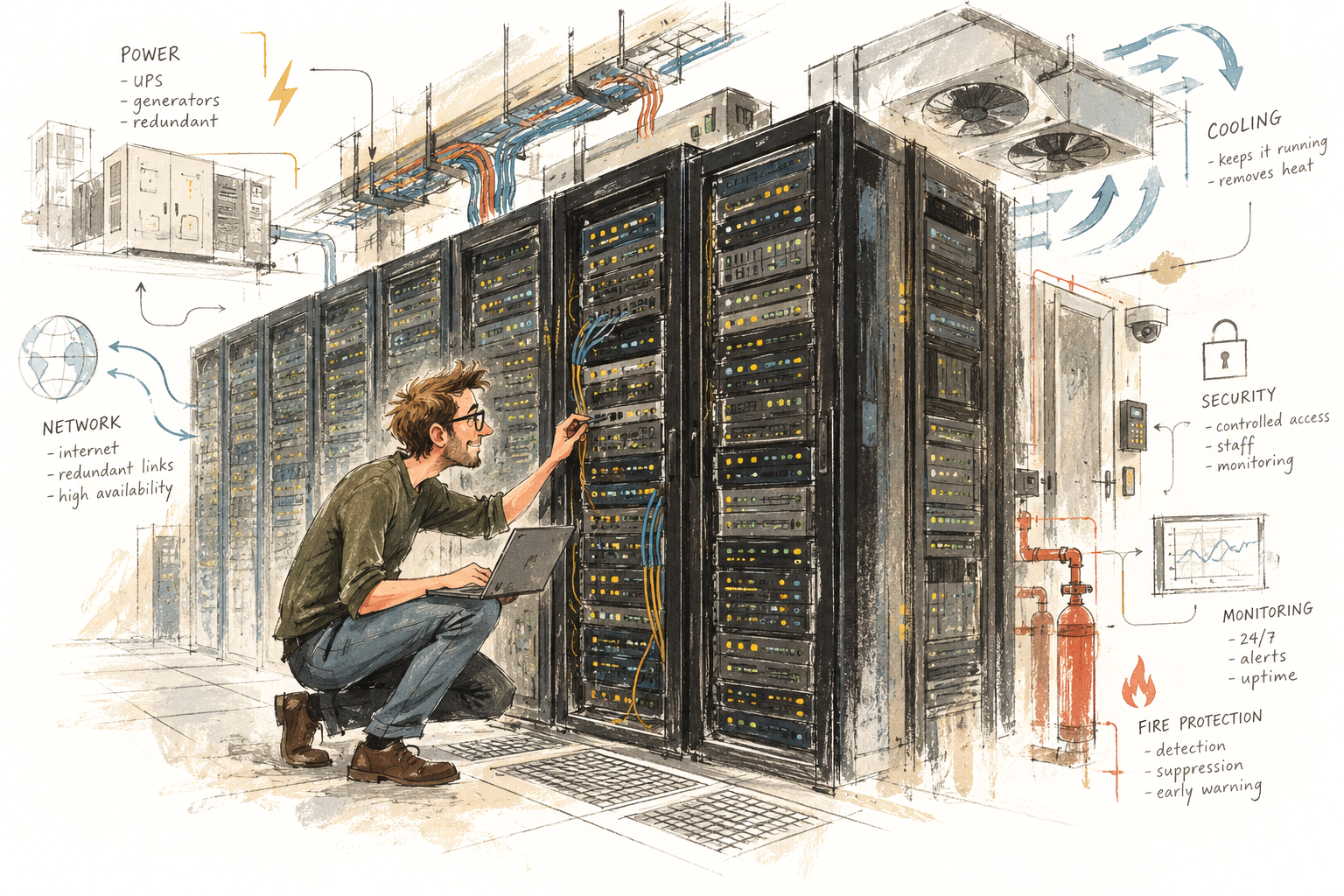
A data center is a facility built to house IT equipment (servers, storage and network devices) and to give it what it needs to run without interruption: power that does not fail, cooling that removes the heat, network links to the outside world, and physical security. It can be a single room in an office building or a campus of halls drawing hundreds of megawatts. What makes it a data center is not the size but the design: everything is built so that the IT keeps running when one part fails or is being maintained.
A server in an office cupboard has none of that. A power cut stops it, a summer weekend overheats it, and anyone with a key can unplug it. A data center replaces each of those risks with engineering: uninterruptible power supplies and generators, redundant cooling, controlled access, fire detection and suppression, and staff or monitoring around the clock. The rest of this topic covers each layer.
Why organizations still have one
Cloud computing has not made data centers disappear; it has concentrated them. Every cloud service runs in a data center, just one owned by the provider. Organizations still run or rent their own space because of:
- Latency and locality: control systems, trading platforms and factory systems that must sit close to the equipment or users they serve.
- Cost at steady load: a workload that runs flat out all year can be cheaper on owned or leased hardware than on rented cloud capacity.
- Control and regulation: data that must stay in a specific place, systems that must be isolated from the internet, or audit requirements that are easier to meet with your own hardware.
- Legacy: mainframes, licensed appliances and old applications that cannot move easily.
The balance is shifting. In the Uptime Institute's Global Data Center Survey 2026, third-party venues (colocation, cloud and software as a service) hosted a larger share of IT workload (46%) than data centers owned by the enterprises themselves, for the first time. Most organizations now use a mix, which the hybrid cloud page describes from the cloud side.
Types of data center
Data centers are usually grouped by who owns the building, who owns the IT inside it, and how big it is.
On-premises
On-premises ("on-prem") means the organization runs the IT equipment in a building it controls, and is responsible for everything: the building, power, cooling, security, hardware and staff. That ranges from a server room in a head office to a dedicated enterprise data center. It gives full control, at the price of carrying every investment and every risk yourself. Small server rooms often have only one power feed and one cooling unit, which makes them fragile; the availability tiers page explains how to judge that.
Colocation
In colocation ("colo") a provider owns and runs the building, power, cooling, security and network entry, and rents space to customers who bring their own servers. The customer pays for space (a few rack units, a full rack, a locked cage or a private suite), for an amount of power (often as kilowatts per rack), and for cross-connects to carriers and other customers. The provider promises availability of power and cooling in a service level agreement; what runs on the servers is the customer's business.
- Retail colocation: racks and cages for many smaller customers, with shared infrastructure.
- Wholesale colocation: whole halls or buildings for a single large customer, often a cloud provider.
Colocation suits organizations that want their own hardware without building a facility. Kestrel Energy, the energy supplier used as an example throughout this site, does both: a small data center at its head office for systems that must stay close, and racks in a colocation facility for its billing platform; the customer portal runs at a public cloud provider.
Hyperscale
A hyperscale data center is a very large facility, typically tens to hundreds of megawatts, built and run by a cloud or internet company (a hyperscaler) for its own services. Everything is standardized: identical halls, custom server designs, automation instead of people at every step. Hyperscalers also rent wholesale colocation, so the name on the building is not always the company inside it. Some countries define the term in law; the Netherlands does, as shown below.
Edge
An edge data center is a small facility placed close to the users or devices it serves: a container next to a mobile mast, a room in a factory, or a small site in a regional city. It exists to cut latency and to process data locally before sending a summary to a central site, which is what edge computing is about. Edge sites are often unstaffed, so remote monitoring and remote management matter even more there; the out-of-band management page covers how that is done.
| Type | Who owns the building | Who owns the IT | Typical size |
|---|---|---|---|
| On-premises | The organization | The organization | One room to a few megawatts |
| Colocation | The provider | Each customer | A few to tens of megawatts |
| Hyperscale | The cloud company (or a wholesale provider) | The cloud company | Tens to hundreds of megawatts |
| Edge | Varies: operator, carrier, factory | Varies | A cabinet to a small room |
The sizes are rough orders of magnitude; there is no official cut between them except where the law draws one.
What is inside
Walk through a data center and most of what you see is not IT. The building is divided into spaces with different jobs.
White space and gray space
White space is the floor area where the IT equipment stands: the data halls with their rows of racks. The name comes from the empty, white-tiled raised floors of early computer rooms. Everything that supports it (electrical rooms, battery rooms, generators, cooling plant, pump rooms) is often called gray space. In a typical facility the gray space is as large as the white space or larger, and it is where most of the construction money goes.
Providers sell white space and power together, and power is usually the scarcer of the two. A hall can have room for 200 racks but only enough power and cooling for 120 of them at the density customers want. That is why colocation contracts and capacity planning talk in kilowatts per rack, a theme that returns on the power and cooling pages.
The meet-me room
The meet-me room (MMR) is the secured room where telecom carriers bring their fiber into the building and where customers connect to them and to each other. A connection between two parties inside the building is a cross-connect: a patch cable or fiber pair run by the provider from the carrier's equipment to the customer's rack, usually for a one-time fee plus a monthly charge. Good facilities have two or more separate fiber entry points into the building, so that one digger in the street cannot cut every carrier at once.
A carrier-neutral facility lets any carrier come in and lets customers choose freely between them; a carrier-owned facility favors its owner's network. Carrier-neutral sites attract many networks, and many networks attract more customers. That is why some facilities also host an internet exchange point, where networks exchange traffic directly. Connecting two sites over fiber is a networking topic; see fiber-optic cable and data center networking.
Support spaces
- Electrical rooms: medium-voltage switchgear, transformers, uninterruptible power supplies and distribution, covered on the power page.
- Cooling plant: chillers, cooling towers or dry coolers, pumps, and the air handlers along the data hall; see cooling and airflow.
- Loading dock and staging: equipment arrives in crates, is unpacked outside the data hall (cardboard and dust do not belong near servers), and is tested before it goes in.
- Security: fences, a controlled entrance, an access control vestibule, cameras and a security desk, explained in physical security and physical security and environmental monitoring.
- Operations: a network operations center or control room, offices, and storage for spare parts.
Who works there
A data center is run by two worlds that must cooperate: the facility and the IT inside it. In a colocation facility they even belong to different companies.
| Role | What they do |
|---|---|
| Facility or critical environment engineer | Operates and maintains power, cooling and fire systems; plans maintenance so the IT load is never at risk |
| Data center technician | Racks and cables equipment, swaps failed disks and power supplies, runs cross-connects, does physical work for customers who are not on site |
| Network operations center (NOC) staff | Watch alarms for the network and the facility around the clock and coordinate the response |
| System and storage administrators | Run the servers, virtualization and storage; often work remotely and come in for hardware work |
| Security officers | Control access, escort visitors, watch cameras and patrol |
| Capacity and site managers | Plan space, power and cooling; handle customers and contracts |
Most failures in data centers are not caused by broken equipment but by people and procedures: the Uptime Institute reports that operations account for more than 70% of downtime. That is why data centers run on written procedures, change approval and maintenance windows, the same discipline as change enablement in IT service management.
Your first visit to the floor
A data hall is an industrial workplace. Expect the following, and follow the site's own induction rules, which always take precedence.
- Access: you need a registered visit or a badge, ID at the entrance, and often an escort. You pass through an access control vestibule one person at a time. Never hold a door for someone else.
- Noise and temperature: thousands of fans make a data hall loud; hearing protection is common. Cold aisles are cool, hot aisles can be well above 35 °C.
- Raised floors: in halls with a raised floor, floor tiles may be lifted for work. Never walk near an open tile, and never lift tiles yourself unless you are trained and allowed to.
- Power: only qualified electrical staff work on power distribution. You plug equipment into the outlets you are assigned; you never open a power distribution unit or touch an uninterruptible power supply.
- Fire suppression: many halls are protected by gas systems. Learn where the exits are and what the pre-discharge alarm sounds like; when it sounds, you leave immediately.
- No cardboard, food or drink in the hall: dust, fire load and spills.
Data centers in the Netherlands
The Netherlands, and the Amsterdam region in particular, is one of Europe's main data center markets, helped by many international fiber routes. That growth has met two limits: land use and the electricity grid.
Hyperscale rules
Since 1 January 2024 a national rule (an amendment of the Besluit kwaliteit leefomgeving, Staatsblad 2023, 492) defines a hyperscale data center as one with more than 10 hectares of built area and at least 70 MW of connection capacity, and allows such sites only at two locations: Eemshaven (Het Hogeland, Groningen) and Agriport A7 (Hollands Kroon, Noord-Holland). Because both conditions must hold, a compact multi-story building with a very large connection falls outside the definition; in January 2026 NOS reported a 78 MW project in Amsterdam on about 2.3 hectares. The function below applies the definition as written.
# Dutch national rule (in force since 1 January 2024): a hyperscale
# data center has MORE than 10 ha of built area AND AT LEAST 70 MW of
# grid connection capacity. Both conditions must be true.
AREA_LIMIT_HA = 10
POWER_LIMIT_MW = 70


def is_hyperscale(built_area_ha, connection_mw):
    return built_area_ha > AREA_LIMIT_HA and connection_mw >= POWER_LIMIT_MW


sites = [
    ("Campus of low halls on farmland", 40.0, 200),
    ("Multi-story towers in a city", 2.3, 78),
    ("Colocation campus", 12.0, 45),
    ("Enterprise data center", 0.4, 3),
]

print(f"{'Site':34}{'ha':>6}{'MW':>6}  hyperscale?")
for name, area, power in sites:
    verdict = "yes" if is_hyperscale(area, power) else "no"
    print(f"{name:34}{area:6.1f}{power:6}  {verdict}")
Site ha MW hyperscale? Campus of low halls on farmland 40.0 200 yes Multi-story towers in a city 2.3 78 no Colocation campus 12.0 45 no Enterprise data center 0.4 3 no
In March 2026 the Tweede Kamer adopted a motion asking the cabinet to tighten the definition, for example by making either condition enough. As of October 2026 no new rule is in force: the definition is under review.
Power is the real limit
According to Statistics Netherlands (CBS), data centers used 4.6% of Dutch electricity in 2024 (5.1 billion kWh, a preliminary figure), up from 3.3% in 2021. About 45 large data centers account for roughly 90% of that. Meanwhile grid congestion means that large consumers in much of the country wait for new or bigger connections; since 1 January 2026 a prioritization framework from the regulator ACM sets the order of that waiting list. In practice, a site with a grid connection is now worth more than a site with land. The energy and sustainability page covers the reporting duties that come with that energy use, in the EU and elsewhere.
Other countries regulate data centers in other ways. The United Kingdom, for example, designated data centers as critical national infrastructure on 12 September 2024, and its Cyber Security and Resilience Bill, before Parliament as of October 2026, would bring colocation data centers with at least 1 MW of rated IT load (enterprise data centers from 10 MW) under its network security rules, with Ofcom as the regulator.
Where to go from here
The pages of this topic follow the path of a workload from the ground up: the facility (redundancy, racks, power, cooling, security), the servers and their remote management, storage, virtualization and networking, and finally protecting and running it all (backup, disaster recovery, lifecycle, energy). If you want a certificate for the facility side, the vendor-neutral EPI Certified Data Centre Professional (CDCP) is a common starting point: a two-day course with a short exam, aimed at people with about a year of data center experience. For the server and storage side, the CompTIA Server+ exam covers much of this topic, as the tags on the relevant pages show.