What Is AI?
What artificial intelligence means and where it came from: definitions, narrow and general AI, the main approaches, and the history from Turing and Dartmouth through the AI winters to deep learning and today's language models.
Defining AI
Artificial intelligence (AI) is the field of computer science that builds systems which perform tasks we would call intelligent if a person did them: recognizing speech and images, understanding and writing text, predicting what happens next, choosing what to do. The term itself dates from 1955, when John McCarthy, Marvin Minsky, Nathaniel Rochester and Claude Shannon used it in their proposal for a summer research project at Dartmouth College.
That description is vague on purpose, because there is no single definition that everyone accepts. The difficulty is that "intelligence" itself has no agreed definition, and the boundary moves: once a task is solved and becomes routine, people tend to stop calling it AI. Route planning, spelling correction and spam filters all started as AI research; today most people just call them software. This is sometimes called the "AI effect".
The EU AI Act's definition
Law needs a workable definition, so the EU AI Act (Regulation (EU) 2024/1689) gives one. Paraphrased, an AI system is a machine-based system that:
- is designed to operate with some degree of autonomy,
- may adapt its behavior after it has been deployed, and
- for explicit or implicit objectives, infers from the input it receives how to generate outputs — predictions, content, recommendations or decisions — that can influence physical or virtual environments.
The key word is infers. A spreadsheet formula or a
hand-written if statement simply executes what a person
decided; an AI system works out its output from patterns or
knowledge, often learned from data. The Act deliberately does not
name techniques, so the definition keeps working as the technology
changes. Other laws use their own wording: US federal law, for
example, defines AI in 15 U.S.C. 9401(3), from the National AI
Initiative Act of 2020. What the Act requires of such systems is
covered on
AI regulation and governance. For a vocabulary that standards bodies share, see ISO/IEC
22989:2022, "Artificial intelligence concepts and terminology".
A field, or a product label?
"AI" is used in two quite different ways, and it helps to notice which one you are reading:
- As a field: a research area with methods, papers and measurable results, such as "this model classifies 90% of tickets correctly on held-out data".
- As a product label: marketing for anything from a genuine machine-learning model to a fixed set of rules or a simple statistic. "AI-powered" on a box tells you little about what is inside.
A useful habit when a vendor says "AI": ask what the system takes as input, what it outputs, what it learned from, and how its quality was measured. Those four answers tell you more than the label.
Narrow AI and general AI
Narrow AI (also called weak AI) is AI built for a specific task or a limited range of tasks: filtering spam, recognizing faces, translating text, recommending films, playing chess. Every AI system that exists today is narrow AI. That includes large language models: they handle a remarkably wide range of text tasks, but they still fail in ways a person would not, and they do not learn from experience after training the way people do.
Artificial general intelligence (AGI) is a hypothetical AI that could understand, learn and perform any intellectual task a human can, across domains, and transfer what it learns from one to another. AGI does not exist. There is no agreed test for it, and experts disagree sharply on whether current methods lead there, and if so when — estimates range from a few years to never. Treat confident claims in either direction as opinions, not facts. The page Limits and myths looks at these claims more closely.
The Turing test
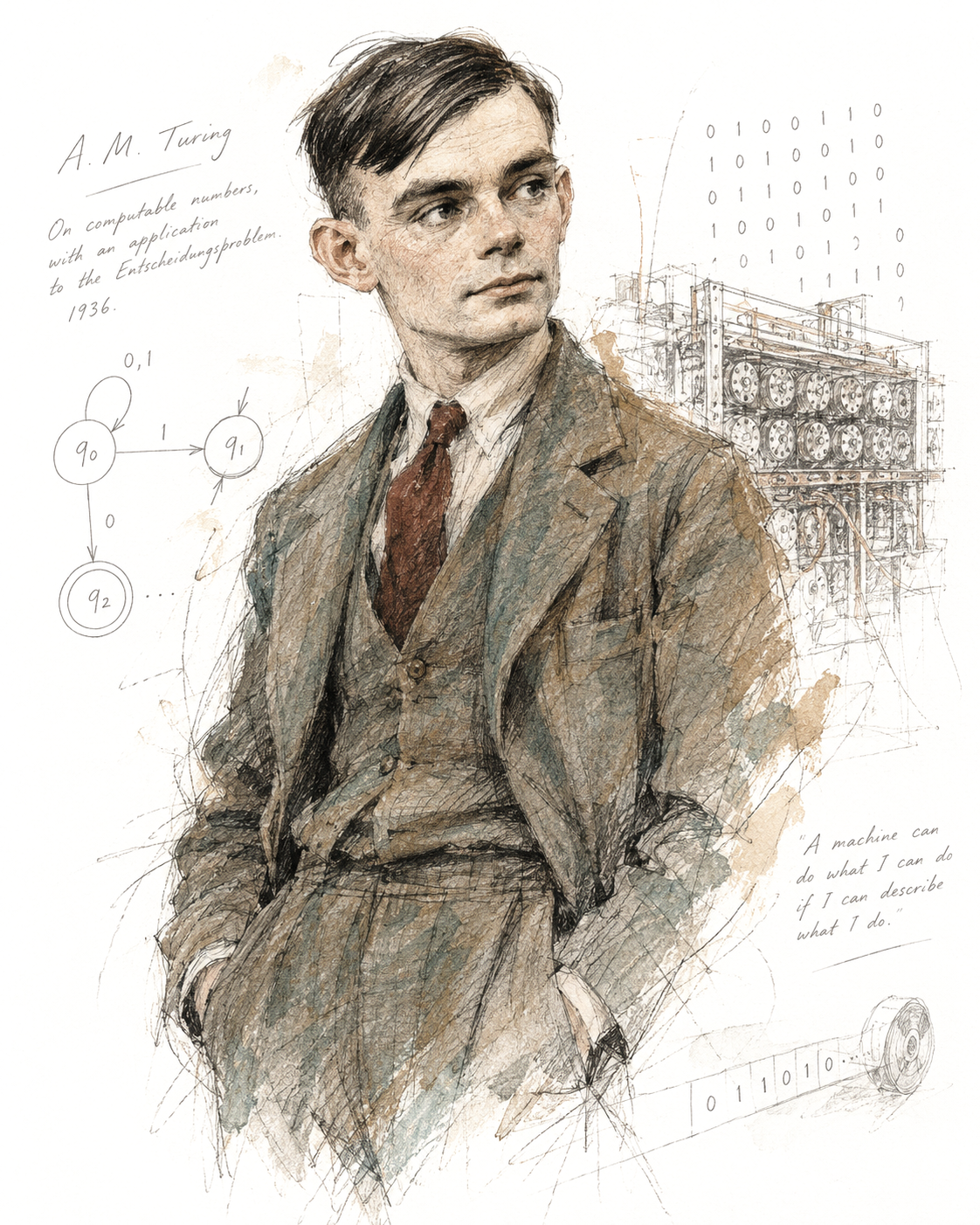
In 1950 the British mathematician Alan Turing published "Computing Machinery and Intelligence". Instead of the unanswerable question "can machines think?", he proposed a practical one, the "imitation game". The Turing test, as it is now known, has a human judge hold text conversations with a hidden person and a hidden machine; if the judge cannot reliably tell which is which, the machine passes.
The test was influential because it replaced philosophy with something you could try. Its weakness is that it measures whether a machine can seem human in conversation, not whether it understands anything. Modern chatbots can produce very human-like text, which shows that fluent conversation and general intelligence are not the same thing.
Two traditions: rules and learning
Since the 1950s, AI research has followed two broad approaches. They are not enemies; many real systems combine them.
Symbolic AI and expert systems
Symbolic AI represents knowledge explicitly as symbols, facts and rules that people write, and reasons by applying those rules ("if the ticket mentions VPN, it is a network problem"). It dominated AI research from the 1950s to the 1980s and is sometimes called "good old-fashioned AI" (GOFAI).
Its best-known product is the expert system: a program that captures the knowledge of human experts in a specific domain as a large set of if-then rules, plus an inference engine that applies them to a case. Expert systems were a commercial success in the 1980s — XCON, for example, configured computer orders at Digital Equipment Corporation — but they were expensive to build, hard to keep up to date, and brittle when a case did not fit the rules.
Here is the idea in miniature: a rule-based router that sends helpdesk tickets to a queue by looking for keywords. (Python basics such as lists and functions are explained in the Python topic.)
RULES = [
    (("vpn", "wi-fi", "wifi", "network", "dns"), "network"),
    (("password", "locked", "login", "account"), "account"),
    (("laptop", "printer", "screen", "keyboard"), "hardware"),
]


def route(ticket):
    text = ticket.lower()
    for keywords, queue in RULES:
        if any(word in text for word in keywords):
            return queue
    return "service desk (manual)"


tickets = [
    "VPN drops every ten minutes",
    "Account locked after holiday",
    "Printer on floor 2 jams",
    "Wi-Fi password expired",
    "New starter needs Teams access",
]
for t in tickets:
    print(f"{t:32} -> {route(t)}")
VPN drops every ten minutes -> network Account locked after holiday -> account Printer on floor 2 jams -> hardware Wi-Fi password expired -> network New starter needs Teams access -> service desk (manual)
Every decision is transparent: you can point at the rule that fired. But look at the last two tickets. "Wi-Fi password expired" went to the network queue because the network rule happens to come first, although it is really an account problem. "Teams access" matched no rule at all. Each fix means another rule, and with hundreds of rules they start to conflict. That maintenance burden is exactly what machine learning tries to remove.
Machine learning
Machine learning (ML) is the branch of AI in which a system learns patterns from example data instead of following rules a person wrote. You give it thousands of tickets that were already routed correctly, and it works out by itself which words and combinations point to which queue — including ones nobody thought to write a rule for. The price is that you need good data, and the learned patterns are harder to inspect than a list of rules. How that learning works is the subject of How machines learn.
| Aspect | Symbolic AI (rules) | Machine learning (data) |
|---|---|---|
| Knowledge comes from | Experts who write rules | Labeled or unlabeled examples |
| Explaining a decision | Easy: show the rule | Harder, sometimes very hard |
| New situations | Fails if no rule fits | Generalizes, if the data covered similar cases |
| Maintenance | Edit rules by hand | Collect new data and retrain |
| Still used for | Business rules, compliance checks, routing, validation | Spam filters, forecasts, image and speech recognition, LLMs |
AI, machine learning, deep learning and generative AI
Four terms that are often used as if they meant the same thing actually nest inside each other:
- Artificial intelligence is the whole field, including rule-based systems, search and planning.
- Machine learning is the part of AI that learns from data. The classic algorithms (regression, decision trees, nearest neighbors) still do much of the practical work.
- Deep learning is machine learning with neural networks of many layers. It drives image recognition, speech recognition and language models; see Deep learning.
- Generative AI creates new content — text, code, images, audio — rather than only classifying or predicting. The term is defined on AI in service management; how the language models behind it work is on Transformers and large language models.
The nesting is a simplification: a few generative techniques are not deep learning, and some systems combine learned models with hand-written rules. As a map for reading news and exam questions, it works well.
A short history
AI has gone through cycles of high expectations, disappointment and renewed progress. An AI winter is a period in which interest and funding for AI research dropped sharply because results fell short of promises. Historians usually name two, but their exact years are a convention and differ between sources.
| When | What happened | Why it mattered |
|---|---|---|
| 1950 | Alan Turing publishes "Computing Machinery and Intelligence" | Proposes the imitation game (Turing test) as a practical question |
| 1955–1956 | McCarthy, Minsky, Rochester and Shannon propose the Dartmouth summer research project (1955); the workshop is held in 1956 | First use of the term "artificial intelligence"; often seen as the founding of the field |
| 1958 | Frank Rosenblatt publishes the perceptron | An early learning machine and an ancestor of today's neural networks |
| about 1974–1980 | First AI winter, after the UK's Lighthill report (1973) and cuts in US research funding | Early promises of general machine intelligence were not met |
| 1980s | Expert systems are sold commercially | Symbolic AI reaches business, and shows its maintenance limits |
| 1986 | Rumelhart, Hinton and Williams popularize backpropagation (earlier forms existed) | A practical way to train neural networks with more than one layer |
| about 1987–1993 | Second AI winter, as the market for specialized AI hardware collapses and expert systems disappoint | "AI" becomes an unpopular label; much work continues as "machine learning" or "statistics" |
| May 1997 | IBM's Deep Blue beats world chess champion Garry Kasparov in a six-game match | Brute-force search plus expert knowledge, not learning |
| 2012 | AlexNet (Krizhevsky, Sutskever, Hinton) wins the ImageNet image-recognition challenge by a large margin | Widely seen as the start of the deep-learning boom, trained on GPUs |
| March 2016 | DeepMind's AlphaGo beats Lee Sedol 4–1 at Go | Deep learning plus reinforcement learning masters a game long thought too hard |
| 2017 | Vaswani et al., "Attention Is All You Need", introduce the transformer | The architecture behind today's large language models |
| 2020 | OpenAI's GPT-3 paper describes a 175-billion-parameter language model | Shows that one large model can do many tasks from a few examples in the prompt |
| 30 Nov 2022 | OpenAI releases ChatGPT as a research preview | Generative AI reaches the general public |
| 2024 | Nobel Prize in Physics to John Hopfield and Geoffrey Hinton; half the Nobel Prize in Chemistry to Demis Hassabis and John Jumper (AlphaFold), the other half to David Baker | Machine learning is recognized as foundational science |
Two patterns stand out. First, the ideas are often old: neural networks date from the 1950s and backpropagation from the 1970s and 1980s; they became useful only when data and compute caught up. Second, each wave brought real, lasting results even when the hype around it collapsed. Expert systems, search and statistical learning are all still in use.
Why now?
If many of the ideas are decades old, why did AI take off in the 2010s? Three things improved at the same time, and each one depends on the others:
- Data. The web, smartphones, digital photos and online text created training data at a scale that did not exist before. AlexNet was trained on about 1.2 million labeled images in 1,000 categories from ImageNet (the full dataset has over 14 million). Language models learn from a large share of the public text on the internet.
- Compute. GPUs, originally built for games, turned out to be very good at the matrix arithmetic that neural networks need. Cloud computing made thousands of them rentable. See AI infrastructure and cloud services.
- Algorithms. Better ways to train deep networks (and, from 2017, the transformer architecture) made it possible to turn more data and compute into better models instead of hitting a wall.
Researchers also found that, for language models, results kept improving fairly predictably as models, data and compute grew. That gave companies a reason to invest heavily. Whether that trend continues, and at what cost in money and energy, is one of the open questions of the field.